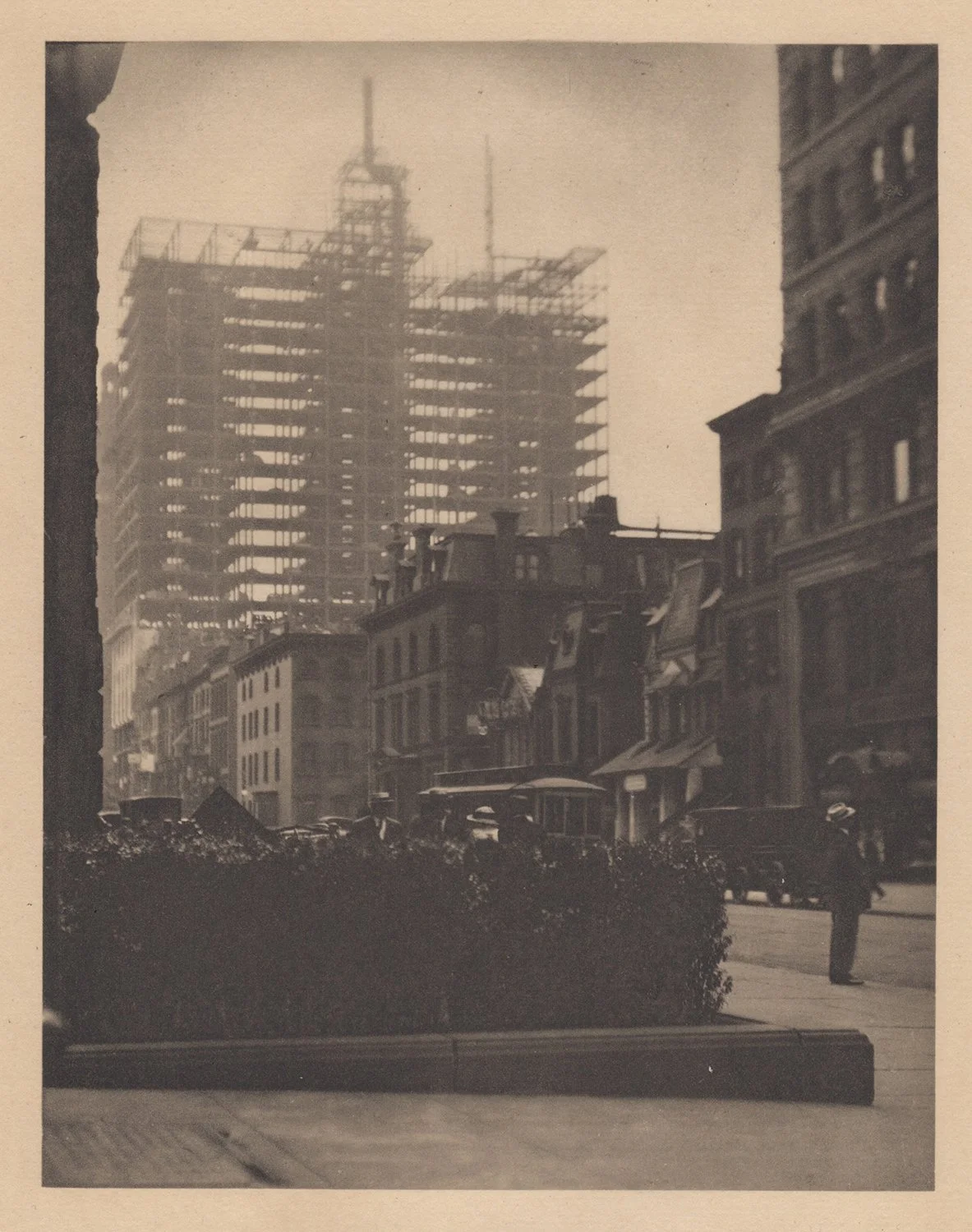
Alfred Stieglitz
Old and New New York, 1910
Vintage hand-pulled photogravure
7.95 x 6.22 inches
Published in Camera Work, No. 36, 1911
By Samuel J. Abrams
Professor of politics at Sarah Lawrence College and a senior fellow at the American Enterprise Institute
The photograph is titled Old and New New York.
Made in 1910 by Alfred Stieglitz, it captures a city caught in the act of remaking itself. In the foreground the street feels modest, almost intimate. Brick buildings line the block. A few figures move along the sidewalk, grounding the scene in the ordinary scale of urban life.
Behind them rises something entirely different.
A skeletal skyscraper climbs into the sky, its steel frame exposed, its floors not yet enclosed. The structure appears almost translucent, a lattice of beams hovering above the older streets below. It is not yet a building so much as the idea of one.
I stood before the image longer than I expected. The steel frame seemed less like a structure than a question the city had begun asking itself. I had seen the picture before in books, reproduced on glossy pages alongside so many other canonical photographs. But seeing it here—fully printed, occupying its own quiet space on a gallery wall—gave it a different weight. It no longer felt like an illustration of history. It felt like an encounter with a moment when the future had not yet decided what shape it would take. The image captures the precise instant when that future begins to overshadow the past.
Standing before Stieglitz’s work at the Robert Mann Gallery, one realizes that the subject is not simply construction. It is transformation. The horizontal city of brick, cornices, and narrow streets still exists, but the vertical city of steel and elevators is already rising behind it.
The New York we now recognize - the skyline, the towers, the sheer vertical ambition of the place - was still in the process of becoming.
That tension between what already exists and what is emerging runs quietly through the exhibition Fragmentary Glimpses: Alfred Stieglitz and David Vestal in New York. The show pairs Stieglitz’s early photographs of the city with images made decades later by David Vestal. And despite being separated by half a century, both photographers grasped something fundamental about cities: Cities are rarely experienced as complete views, they appear instead through fragments.