Jeff Brouws:
silent monoliths
October 29—December 12, 2026
PRESS RELEASE
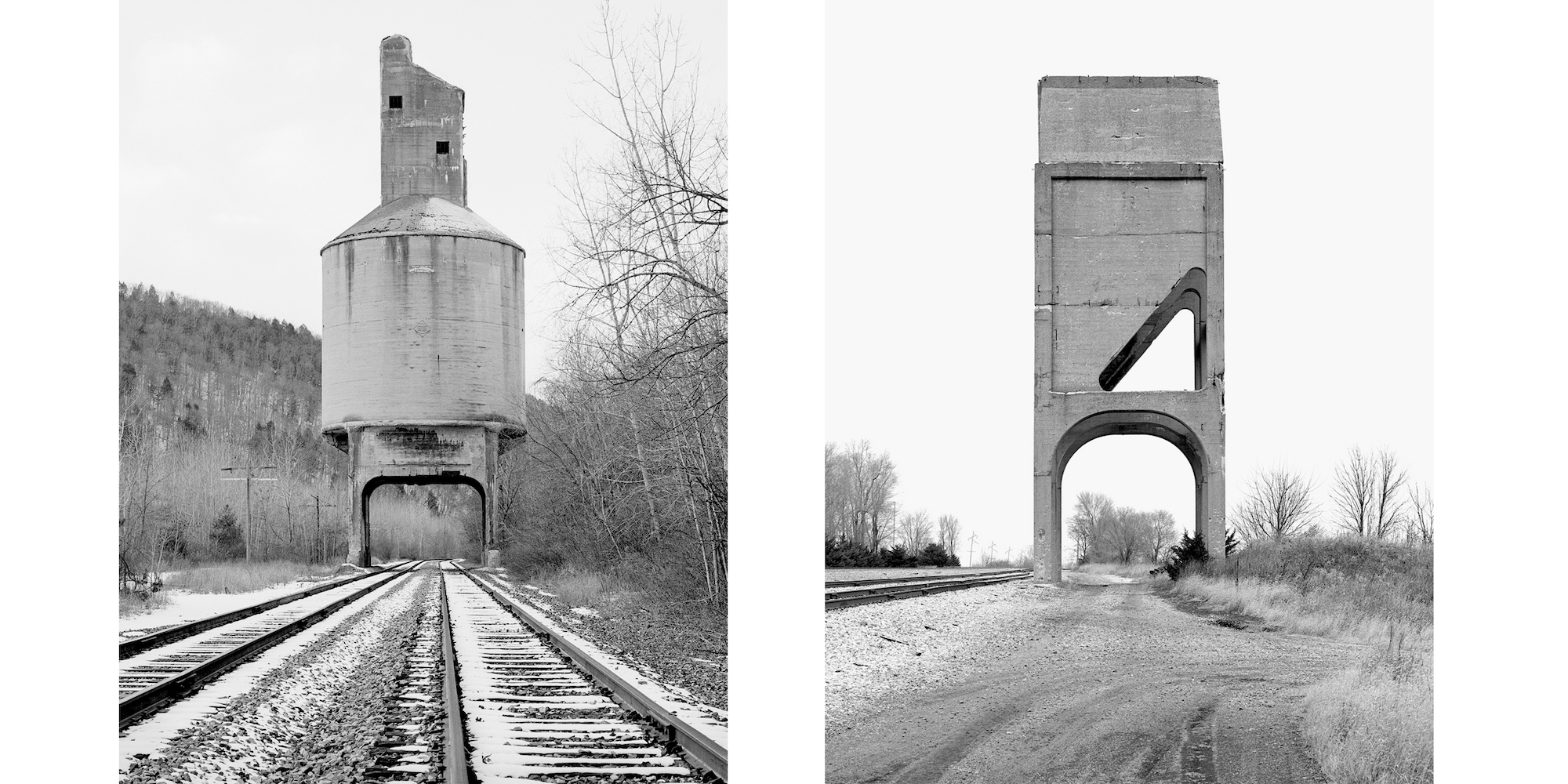
Coaling Tower No. 7a, Looking West, Susquehanna, Pennsylvania, 2015 Coaling Tower No. 8a, Looking North, Gilman, Illinois, 2014
Opening Reception & Artist Talk: October 29, 6 - 8 pm
Robert Mann Gallery is pleased to announce Jeff Brouws: Silent Monoliths, an exhibition by American photographer Jeff Brouws (b. 1955) that showcases his landmark series documenting the architectural remnants of America’s railroad history, featured in his critically acclaimed book Silent Monoliths: The Coaling Tower Project (MIT Press). Acting as a "visual anthropologist," Brouws utilizes a precise, deadpan typological approach to capture these industrial monuments left behind by technological shifts across the United States.
Between 1907 and 1956, the country’s rapidly growing railway industry constructed hundreds of massive reinforced-concrete structures designed to hold several hundred tons of coal used to fuel steam locomotives. As the industry transitioned from steam to diesel throughout the 1950s, these behemoth structures eventually became obsolete. Although some were torn down, many have remained in place, acting as abandoned witnesses to the rise and fall of American railroading.
Over five years and covering more than 20,000 miles, Brouws systematically documented these dormant, sculptural artifacts: photographing each towering structure under flat, overcast light, he presents these silent monoliths as imposing, monumental testaments to the perplexing contradictions of modern industrialization.
Brouws’ Coaling Tower Project is an extension of his over 35 year career chronicling the shifting, multifaceted commercial and industrial topography of the American cultural landscape, using his camera to construct rigorous photographic typologies and deliberate narrative frameworks. His practice has investigated the socio-spatial and socio-economic remnants of mid-century idealism and subsequent late-stage capitalism—with subjects ranging from the interstate highway system and corporate sprawl to post-industrial urban decay.
His work directly engages in a critical dialogue with the New Topographics movement, which reframed the American landscape by focusing on man-altered spaces rather than pristine nature. Brouws also builds upon the pioneering strategies of forebears like Ed Ruscha and Bernd and Hilla Becher, preserving the ephemeral iconography of the American built environment. By capturing sites of obsolescence and neglect, the spaces he photographs become melancholic meditations on an ever-changing, ever-evolving national identity.
Complementing these large black-and-white photographs of coal towers in an adjunct installation is a grid of color works from Brouws’ series Signs Without Signification. In stark contrast to the heavy concrete of the coaling towers, this portfolio examines the skeletal, stripped frameworks of defunct commercial signage. Together, these twin typologies transform images of industrial infrastructure and commercial decay into a contemplative commentary on the collective, fading landscape of America’s built environment.