Fragmentary Glimpses:
Alfred Stieglitz and David Vestal in New York
February 5 – april 11, 2026
PRESS RELEASE | images
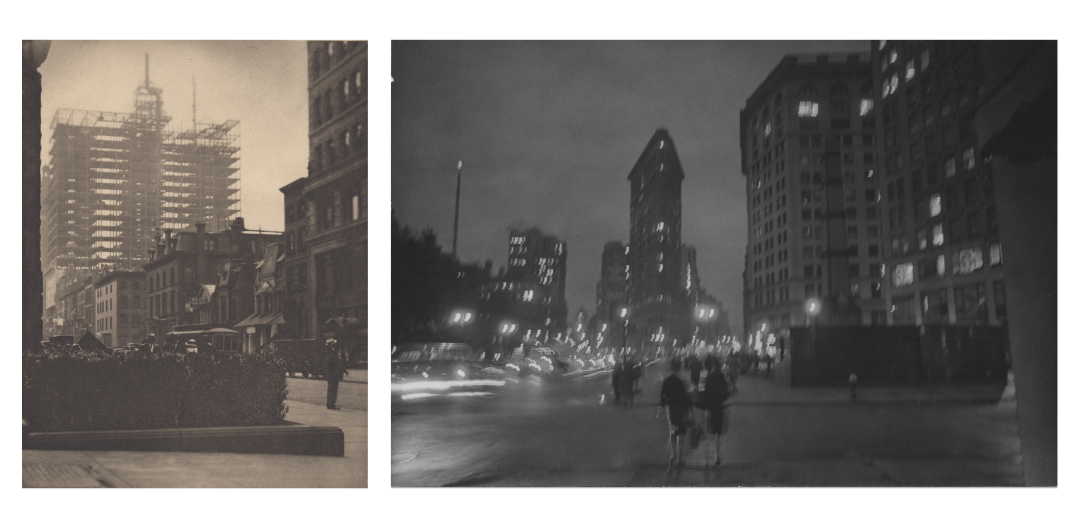
One thing is certain about New York City—it is always changing. We know this on an instinctual level, but the art of the times is what reveals the city’s shapeshifting energy. As a versatile medium, photography both documents what a camera views while simultaneously revealing more than what is seen at any given moment.
Robert Mann Gallery is pleased to present Fragmentary Glimpses: Alfred Stieglitz and David Vestal in New York, on view starting February 5. This intimate exhibition invites viewers to look at New York through the lens of two photographers who were infatuated with the city’s ever-evolving landscape: Alfred Stieglitz and David Vestal.
In the early 1900s, Alfred Stieglitz hosted modern art exhibitions at his Little Galleries of the Photo-Secession—named after the Pictorialist group he helped found in 1902—and promoted photography as a legitimate art form through the pages of Camera Work. From 1903 to 1917, this quarterly journal showcased new work by leading artists alongside art criticism and philosophical essays. While the journal primarily featured the work of others, the October 1911 issue focused on Stieglitz’s own photographic vision and is considered one of the journal’s most important issues.
Fragmentary Glimpses presents the entire collection of images that Stieglitz published for Camera Work, No. 36 — “snapshots” (as critics called them) of New York at one of its many turning points. Steamboats and locomotives transport people faster and further than ever before, while airships and newly built skyscrapers usher in an era of reaching new heights. Such iconic works as The Steerage (1907), The Terminal (1892), and Spring Showers (1900) demonstrate how Stieglitz’s modernist framing and ability to render the city’s changing atmosphere—both natural and man-made—helped initiate a new direction for photography at the turn of the twentieth century. A main figure in and proponent of Pictorialism, Stieglitz mastered the photogravure technique, a photomechanical process that allowed for atmospheric and painterly effects while being mass produced.
Decades later, David Vestal photographed the city and its people living in modernity’s shadowy aftereffects. Arriving to New York in the late 1940s after studying painting at The Art Institute of Chicago, Vestal took up photography and joined the renowned Photo League of socialist practitioners. Distinctly more steeped in aesthetic concerns than political ones, his sensitive compositions and attention to light still skillfully capture the unsettling social realities that lingered like smog in most postwar American cities.
The title for this duo show comes from an essay featured in Stieglitz’s October 1911 issue of Camera Work. Referring to New York as “a vision that rises out of the sea,” the photographer Alvin Langdon Coburn writes how the city “glimmers for a while in the sun…[then] vanishes, but for fragmentary glimpses….” Both Stieglitz and Vestal knew intimately how their cameras could both capture the city’s insatiable hunger for progress while depicting its illuminous and hazy luster.
View the exhibition in person and online starting February 5, 2026. Public visiting hours are Tuesday–Friday, 10am–6pm, and Saturday from 11–6pm. For additional hours please make an appointment. For additional information and press materials, please contact the gallery by email (mail@robertmann.com).
Capturing the City: ‘Fragmentary Glimpses: Alfred Stieglitz and David Vestal in New York’ at the Robert Mann Gallery
by The Science Survey
There is an essay buried in the pages of Camera Work, No. 36 that contains, to me, one of the most simple yet compelling descriptions of New York City ever written. “Now, to me,” Alvin Langdon Coburn, a pioneer photographer in his own right, wrote, “New York is a vision that rises out of the sea as I come up the Harbor on my Atlantic liner, and which glimmers for a while in the sun for the first of my stay amidst its pinnacles, but which vanishes, but for fragmentary glimpses, as I become one of the grey creatures that crawl about like ants at the bottom of its gloomy caverns.” Coburn saw the city as something alive and perpetually changing, only able to be captured if you’re quick enough to pull out your camera and photograph it.
That passage gives its name to the Robert Mann Gallery’s current exhibition, Fragmentary Glimpses: Alfred Stieglitz and David Vestal in New York. Tucked inside a large building at 508 West 26th Street, between 10th and 11th Avenues, in Suite 9F in the Chelsea Art District of Manhattan, don’t feel discouraged by the unconventional entrance to the Robert Mann Gallery. At the outside of the exhibit, expect to be greeted by an antique manual elevator, an array of rentable studios, and finally, a small, warm-tone room lined with no more than 30 photos. The show pairs a rare, near-complete collection of photographs from Stieglitz’s own Camera Work No. 36 — the landmark October 1911 issue of Alfred Stieglitz’s quarterly photography magazine — with a selection of post World War II street photographs by David Vestal, a lesser-known but still impactful figure in photography. The result is one of the more unassuming yet thoughtful exhibitions currently on view in the city. Read the full article.
Robert Mann Gallery
by Modern Renaissance Magazine
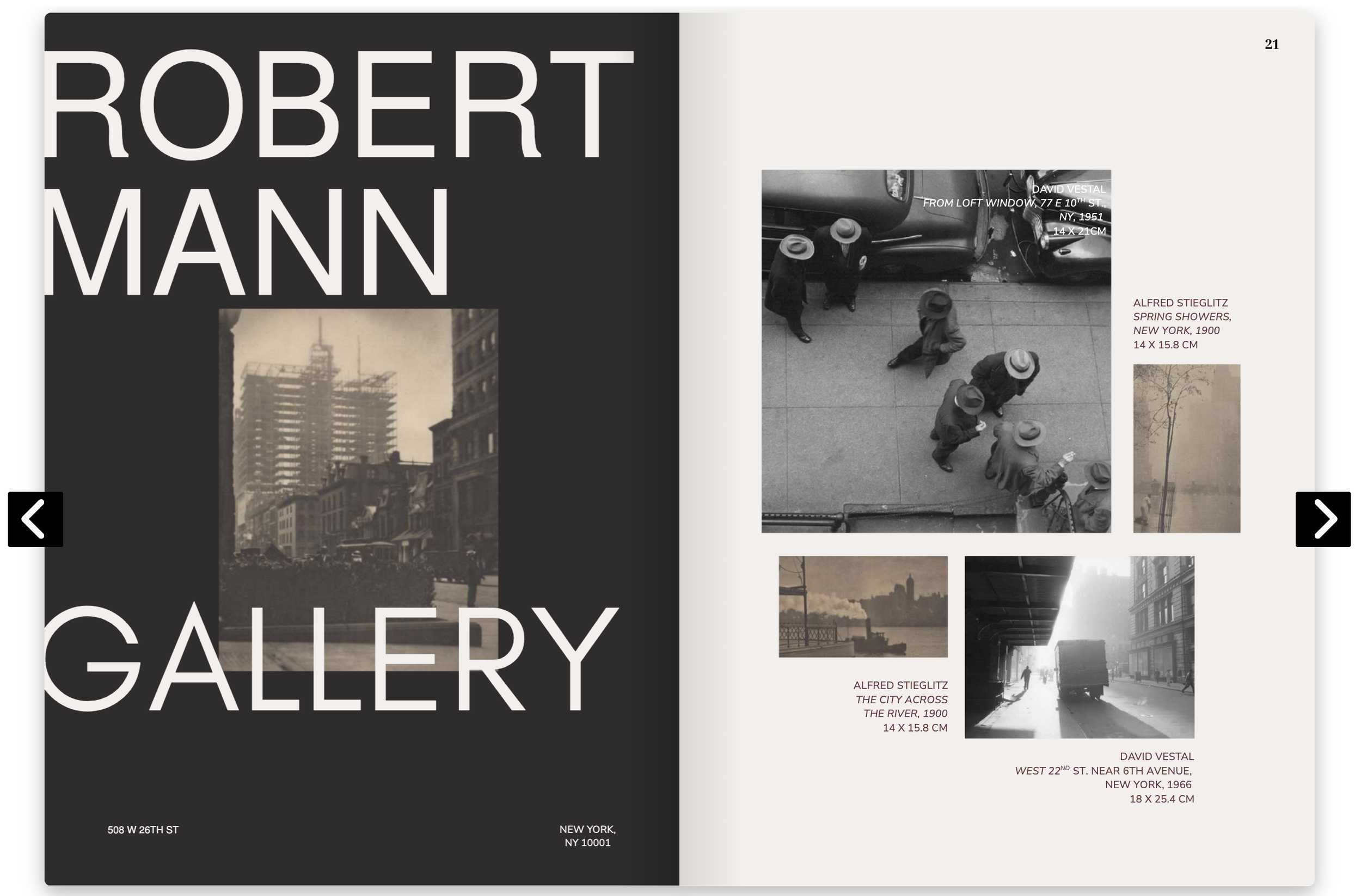
Read the full feature on Modern Renaissance Magazine's website
Gallery feature is on Page 20
The City That Appears in Fragments
By Samuel J. Abrams
The photograph is titled Old and New New York.
Made in 1910 by Alfred Stieglitz, it captures a city caught in the act of remaking itself. In the foreground the street feels modest, almost intimate. Brick buildings line the block. A few figures move along the sidewalk, grounding the scene in the ordinary scale of urban life.
Behind them rises something entirely different.
A skeletal skyscraper climbs into the sky, its steel frame exposed, its floors not yet enclosed. The structure appears almost translucent, a lattice of beams hovering above the older streets below. It is not yet a building so much as the idea of one.
I stood before the image longer than I expected. The steel frame seemed less like a structure than a question the city had begun asking itself. I had seen the picture before in books, reproduced on glossy pages alongside so many other canonical photographs. But seeing it here—fully printed, occupying its own quiet space on a gallery wall—gave it a different weight. It no longer felt like an illustration of history. It felt like an encounter with a moment when the future had not yet decided what shape it would take. The image captures the precise instant when that future begins to overshadow the past. Read the full essay.
Fragmentary Glimpses: Alfred Stieglitz and David Vestal in New York
by Musée Magazine
The city keeps changing. Alfred Stieglitz understood this before anyone had the language for it. Fragmentary Glimpses: Alfred Stieglitz and David Vestal in New York, on view at Robert Mann Gallery in New York City, presents the complete set of images Stieglitz published in his quarterly magazine Camera Work No. 36, returning them to the city that made them necessary. Stieglitz photographed New York at a moment of violent transformation.
Steamboats crowded the harbor. Locomotives split the skyline with smoke. Skyscrapers rose faster than the eye could follow. The city was becoming something unprecedented and Stieglitz was determined to record not just what it looked like but how it felt to stand inside it. “The Terminal (1892)” places the viewer at street level, close enough to feel the breath of horses pulling streetcars through snow. “The Steerage (1907)” divides a ship’s deck into two social worlds separated by a single chain. “The Hand of Man (1902)” fills the frame with locomotive smoke and rail tracks converging toward an industrial horizon. These are not picturesque images of a city. They are arguments about what photography could capture and depict. Read the entire article.